


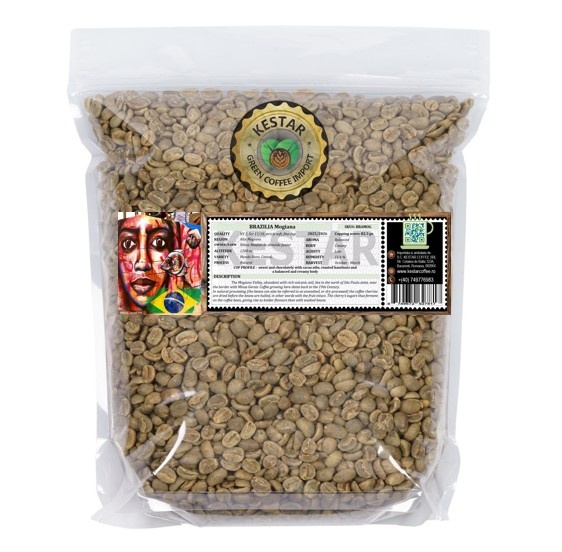


BRAZILIA Mogiana

Description

Processing: Natural; SCA Score: 83 points.
Rich in red volcanic soil, the Mogiana region is located between São Paulo and Minas Gerais. There are some microclimate differences, but in general, the quality of the coffee produced is very high. The Mogiana region produces coffee lots with much clearer flavors than the rest of Brazil. The predominant aromas in this area are roasted nuts and chocolate. The coffee from Mogiana is considered one of the best in the world, featuring a strong body, fruity taste, and acidity. Some variations come with notes of chocolate, nuts, or caramel.
Coffee production in Brazil accounts for about one-third of the world's total coffee production, making it by far the largest producer in the world for the past 150 years. In central Brazil, the vast Cerrado savanna is interrupted by seemingly endless plateaus called Chapadas. These plateaus cover the states of Goiás, Mato Grosso do Sul, Mato Grosso, Tocantins, and Minas Gerais, turning them into one of the largest coffee-producing areas in the world. Around Minas Gerais, farmers have started focusing mainly on cultivating specialty coffee. The well-defined seasons, with hot and humid summers and pleasantly cool and dry winters, favor coffee cultivation in this region.
This coffee was produced in the Mogiana region. Brazilian coffees are uniquely detailed in their classification: NY 2 stands for "New York 2" and refers to the maximum number of defects allowed according to the New York stock exchange's defect counting method—it is the highest grade. Screen 17/18 defines the bean size, indicating that this coffee has larger beans among Brazilian grades.
The Strictly Soft & Fine Cup describes the cup quality, requiring a smooth, consistent, and clean taste. The most common processing method in Brazil, used for about 90% of Arabica coffees, is the dry process, correctly described as natural. The whole coffee cherry is first cleaned and then placed in the sun to dry in thin layers on terraces or dried using mechanical dryers.
Brazilian coffee plantations often cover vast areas of land, requiring hundreds of workers to manage and operate them while producing large quantities of coffee.