




RWANDA Nyamasheke Akagera

Description
Roast Profile: Suitable for both espresso and filter brewing.
Grind: Whole beans (standard delivery).
Recommended Degassing Period:
- Espresso: 10–14 days after roasting
- Filter: 7 days after roasting
To ensure maximum freshness, KESTAR COFFEE roasts every coffee to order. By default, all coffees are shipped as whole beans in premium packaging equipped with a one-way degassing valve to preserve freshness and aroma.
If you would like your coffee ground, please specify your preferred brewing method in the "Order Comments" section before completing your purchase (e.g. espresso, filter, moka pot, Turkish coffee, French press, etc.).

Processing: Natural
SCA Score: 87 points
Cup Profile: An elegant and balanced cup with notes of blueberries and jasmine tea, complemented by a natural sweetness.
Located in the Nyamasheke District of Rwanda's Western Province, the Akagera Washing Station benefits from coffee farms nestled on the high slopes surrounding Lake Kivu. At elevations ranging from 1,600 to 2,000 meters, coffee trees thrive in an exceptional terroir of volcanic and loamy soils, whose composition varies across the region's diverse microclimates. These unique growing conditions create coffee cherries with outstanding aromatic potential.
The cherries are hand-picked by local smallholder farmers only at peak ripeness and delivered immediately to the washing station, where every lot undergoes strict quality control and traceability checks. The influence of Lake Kivu creates a stable microclimate that regulates humidity while complementing the mineral richness of the volcanic soils. This natural synergy promotes high sugar development in the fruit, resulting in a coffee with remarkable complexity, elegance, and sweetness.
Processing begins with a meticulous two-stage sorting process. First, the cherries are hand-sorted to retain only fully ripe, deep-red fruit. They then undergo density sorting by flotation, where the heaviest and highest-quality cherries are separated from underripe or defective ones.
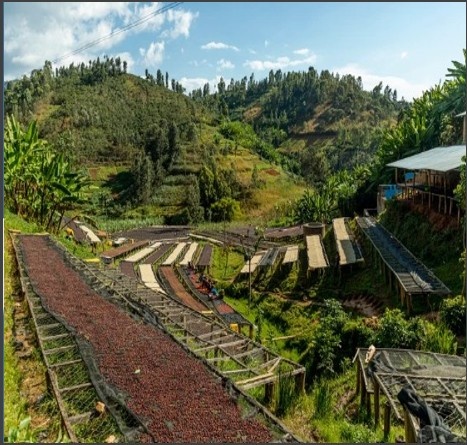
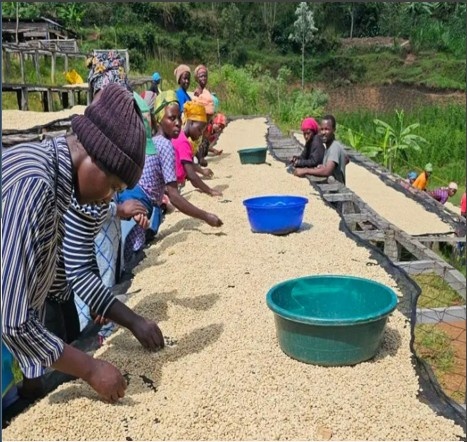
After sorting, the cherries are spread in thin layers on raised African drying beds, where they dry slowly for approximately 38 days. To ensure even drying and prevent over-fermentation, the coffee is turned by hand every four hours and protected with shade covers during periods of intense sunlight or unexpected rainfall. Throughout the drying process, each lot is continuously monitored and carefully hand-sorted to remove any remaining defects, ensuring a clean and expressive final cup.